Songs you know by heart sound wrong: sour, doubled, like a slightly detuned choir. Voices are mostly fine, but music isn't. You're not imagining it, and it often has a name.
By the developer of Harmonic Recovery, who has diplacusis · not a clinician · Last reviewed September 25, 2026
A quick way to tell
Try this with earphones and a song or instrument you know well:
Listen with only your left earphone in, then only your right.
Hum or play along with a held note in each ear.
Notice whether one ear sounds higher or lower, or whether music only sounds wrong with both ears.
If each ear sounds fine on its own but the two disagree on pitch, that's the pattern of
binaural diplacusis: the same note heard at a
different pitch in each ear. For a rough measurement, try our free
online pitch check.
Why music, and not speech?
Speech is understood from its rhythm and the shape of its sounds, which a small pitch shift
barely changes. Music depends on exact pitch. Two notes a quarter of a semitone apart already
clash to a trained ear, so a mismatch between your ears that you'd never notice in
conversation can make a chord sound sour.
When both ears hear the same song, your brain gets two slightly different versions of every
note. Sometimes it merges them into one pitch, and sometimes you hear the clash as a chorus,
a doubling or a beating wobble. People with hearing loss tend to merge pitches that are much
further apart than people with normal hearing, which may be why the effect can seem to come
and go.
What can cause it?
The inner ear sorts sound by pitch along its length. When it's damaged or swollen with fluid
in one ear, the same note can register at a slightly different place, and so at a different
pitch. Diplacusis is linked with:
Hearing loss in one ear, or one ear worse than the other. The worse ear usually hears notes higher.
Sudden hearing loss, which needs a doctor straight away. Read more.
Ménière's disease, where at least half of people are estimated to have diplacusis.
A temporary blocked ear, from a cold or earwax for example, can also make music sound odd.
Whatever you suspect, a new change in how you hear is worth having checked by an audiologist
or ENT doctor.
Other things that can make music sound wrong
Before assuming it's your ears, rule these out:
Your device. Check the left/right balance and Mono Audio settings on your phone, and try different earphones.
Spatial audio and effects. Head tracking, spatial audio and some EQ presets change how each ear hears a song.
One earbud seated badly. A poor seal changes loudness and tone in that ear.
If music still sounds out of tune with plain earphones, balance centered and effects off, and
especially if the change is new, see a professional.
What can I do about it?
First, get the cause checked; some causes are treatable, and sudden hearing loss is urgent.
There's no proven treatment for diplacusis itself, but you can:
measure it the same way over time, so you know whether it's changing
protect your hearing from loud sound
keep playing and listening, if it helps you enjoy music again
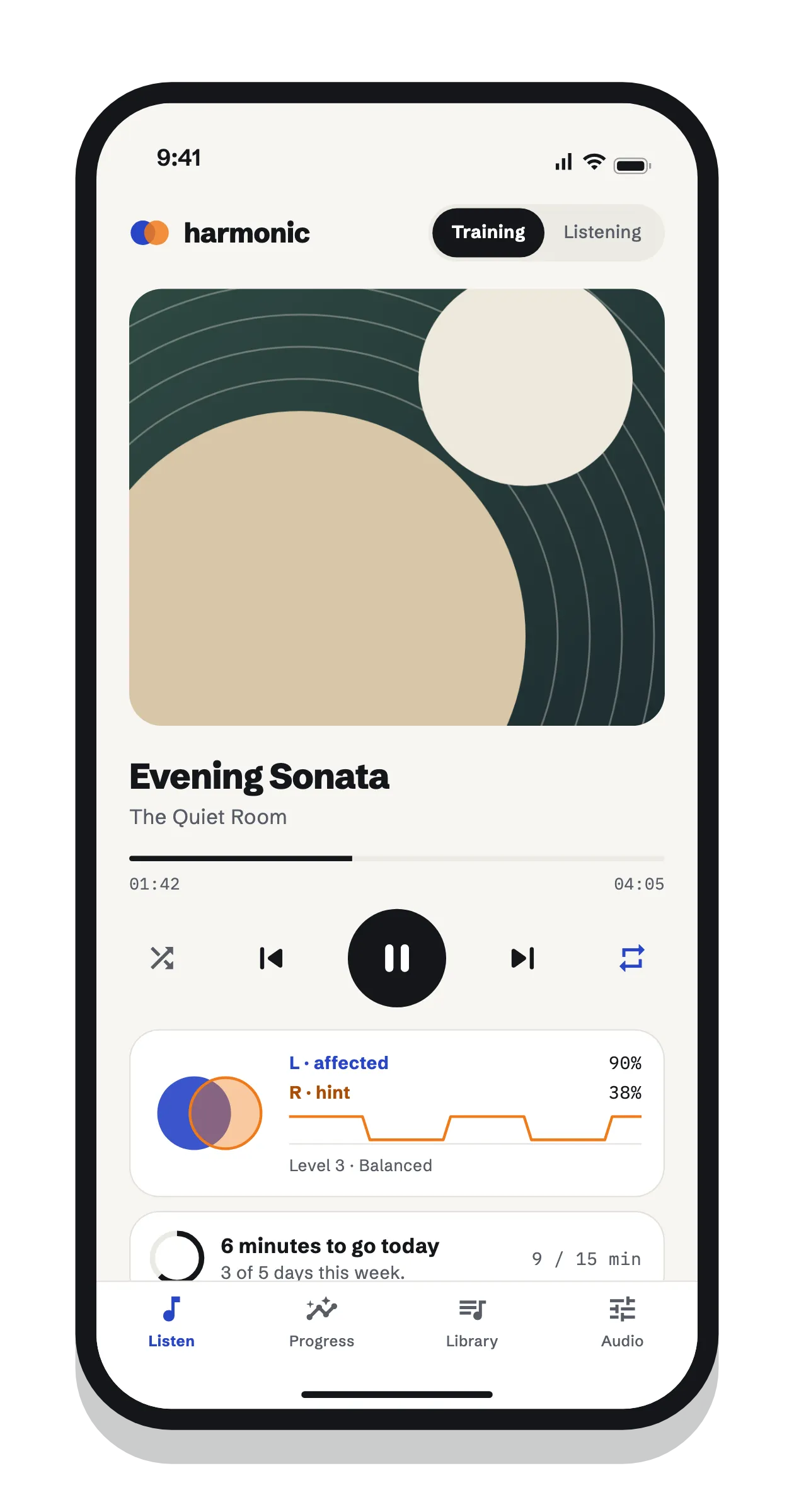
Harmonic Recovery was built for this. It plays your own songs clearly in your affected ear
while the same music fades in and out in your other ear, as a pitch reference. It measures
your mismatch in cents, and a chart shows whether anything changes. It's a practice tool,
not a treatment, and no study has yet tested whether the practice helps. See how it works.
This page summarizes published research and public health sources for general
information. It is not medical advice. An ENT or audiologist can examine your ears and
tell you what applies to you.
Harmonic Recovery
Measure it properly, and practice with your own music
A headphone setup tuned to each of your ears, a pitch-matching check at six frequencies,
a pitch hint that plays in your other ear while you listen to your own songs, 3-minute
drills, and a chart that shows whether anything is changing. Free to start.
On a computer? Scan with your phone's camera to open the app in its store.