If your instrument sounds in tune in one ear and off in the other, or your own voice seems flat on one side, you're not losing your ear. You may have diplacusis, and musicians are often the first to notice it.
By the developer of Harmonic Recovery, who has diplacusis · not a clinician · Last reviewed September 25, 2026
Why musicians notice it first
Most people would shrug off a small pitch difference between their ears. Musicians can't:
you tune to a few cents, you hear when a chord's third is sour, and you know exactly how a
recording should sound. A mismatch of a quarter of a semitone, which a non-musician might
never notice, can make every chord you play sound wrong.
Musicians describe it as:
an instrument that tunes perfectly with a tuner but sounds out of tune in one ear
chords and harmonies that beat or clash when they shouldn't
trouble singing in tune, or your voice sounding flat or sharp on one side
ensemble playing where everyone seems slightly off
in-ear monitors or headphones making it much more obvious
How common is it in musicians?
Less studied than it should be. A 2018 systematic review of hearing in professional musicians
found that diplacusis was examined in only two studies, covering 380 players. About 6% had
it, more in the classical players studied than in the pop and rock players. The same review
found hearing loss far more often. Because diplacusis usually comes with some hearing damage,
anything that damages hearing, including years of loud rehearsal and performance, raises the
risk.
What causes it
Diplacusis happens when the inner ear of one ear maps pitch differently from the other,
usually because of damage or fluid changes in that ear. For musicians, the usual suspects are:
noise exposure: loud stages, rehearsal rooms, monitors, and one-sided sources like a drummer's cymbal or a violin under the chin
sudden hearing loss, which needs a doctor straight away
Ménière's disease and other inner-ear conditions
Loudness matters too: in damaged ears, pitch can shift more than normal as sound gets louder.
So the mismatch may be worse at performance volume than in quiet practice.
Measuring it like a musician
You'll want numbers, and you can get them. Pitch mismatch is measured in cents, the same unit
as your tuner. The method is pitch matching: a tone in one ear, then the other, adjusted until
they sound the same. A careful measurement:
plays the ears one at a time, never together
matches loudness first
tests several frequencies, since the mismatch is often worst in one register
repeats each match, so you know your own normal variation
Try the free online pitch check for a first reading. Knowing
which register is worst is useful: it tells you where to trust your other ear, or a
tuner, rather than the affected one.
Practical tips
Protect your hearing: musician's earplugs with flat attenuation, sensible monitor levels, rest after loud sessions.
Tune with a tuner or your better ear when the mismatch is large, instead of fighting what the affected ear tells you.
Check both ears separately when something sounds off, so you know whether it's the instrument or the ear.
Get new changes checked. A sudden change in hearing or pitch needs a doctor quickly, and an audiologist can advise on protection.
Practicing with Harmonic Recovery
Harmonic Recovery was built by someone with diplacusis, around music. It plays your own songs
clearly in your affected ear while the same music fades in and out in your other ear as a
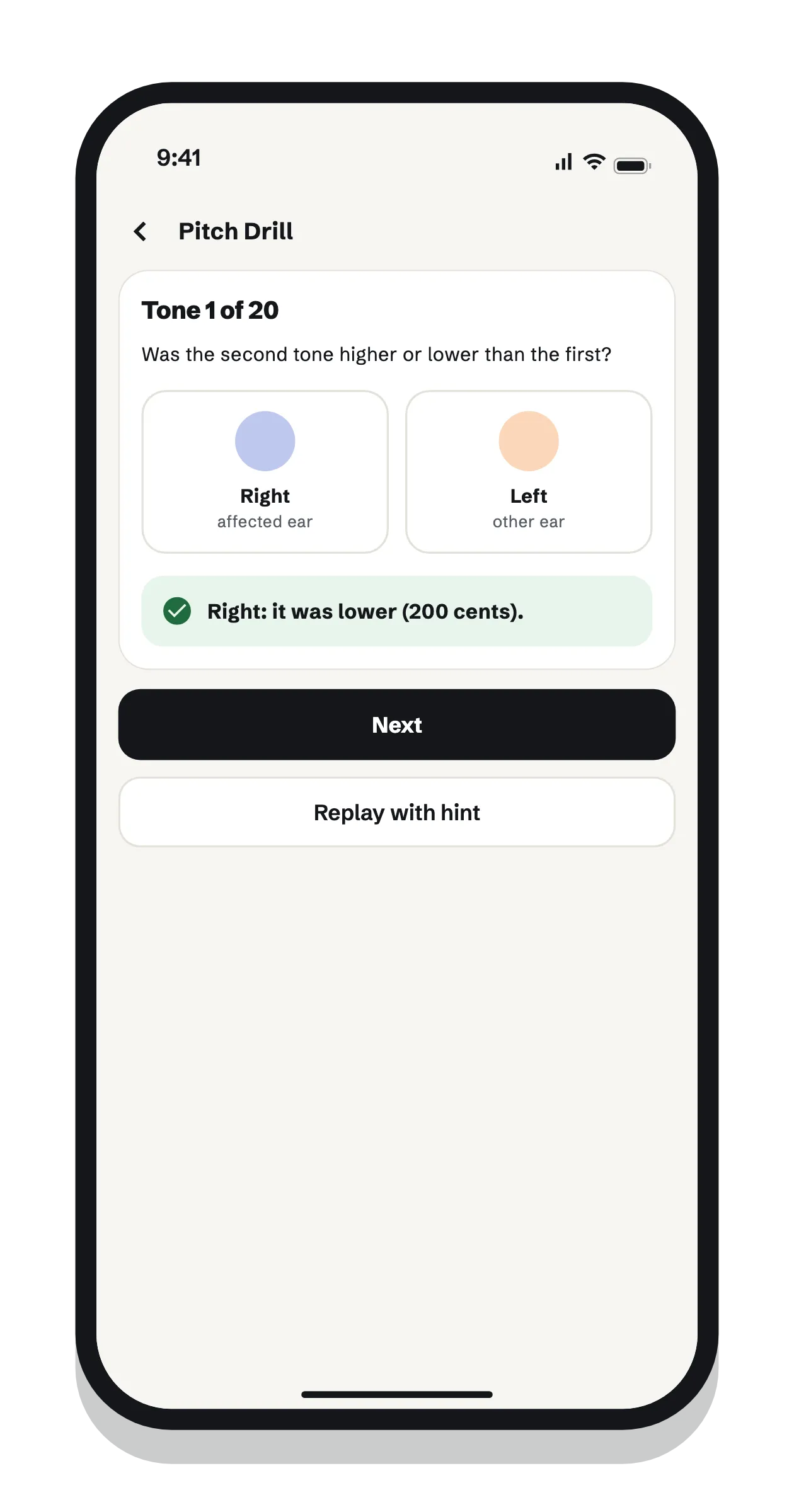
pitch reference. It also offers 3-minute higher-or-lower drills in cents, and a hearing check
that tracks your mismatch over time. It's a practice and measurement tool, not a treatment,
and no study has tested whether the practice reduces diplacusis. The measurement will tell
you honestly whether yours is changing. See how it works.
This page summarizes published research and public health sources for general
information. It is not medical advice. An ENT or audiologist can examine your ears and
tell you what applies to you.
Harmonic Recovery
Measure it in cents, and train with your own music
A headphone setup tuned to each of your ears, a pitch-matching check at six frequencies,
a pitch hint that plays in your other ear while you listen to your own songs, 3-minute
drills, and a chart that shows whether anything is changing. Free to start.
On a computer? Scan with your phone's camera to open the app in its store.