The short answer
-
If the hearing loss behind it recovers, the diplacusis can too. This has
been seen after sudden hearing loss.
-
If it comes and goes with the cause, as with Ménière's disease, it can come
and go with it.
-
If the hearing change is lasting, nobody knows for sure. Researchers expect
the brain to adapt over time, and there's good evidence adult pitch perception can
shift, but diplacusis itself hasn't been followed in large long-term studies.
When the cause recovers
About half of people with sudden hearing loss get some or all of their hearing back on their
own, usually within one to two weeks, and early treatment improves the odds. In one carefully
measured case, a patient's hearing recovered fully within four weeks of steroid treatment,
and their diplacusis returned to normal shortly after. One case isn't proof, but it fits what
you'd expect: if the inner ear heals, its pitch map can go back to normal.
With Ménière's disease, diplacusis is linked to fluid build-up in the inner ear, which rises
and falls. People with Ménière's often notice the pitch getting worse and better along with
their other symptoms.
Can the brain adapt?
Some of the best evidence that adult pitch perception can change comes from cochlear implants.
When someone first gets an implant, a given electrode often sounds far higher or lower in
pitch than expected. Studies that followed implant users found the pitch they heard shifted
over months and years, sometimes by as much as two octaves. In people who still had some
natural hearing, it moved toward the pitch their natural hearing heard. The brain
seemed to use the natural hearing as a reference and recalibrate the implant.
That doesn't mean it always happens. Some implant users don't adapt, or adapt the other way,
and an implant isn't the same as diplacusis. But it shows adult pitch perception isn't fixed.
Researchers studying diplacusis have written that, over time, the brain's plasticity "can be
expected to reduce" it. That's a reasonable expectation, not yet a measured result.
Practice also changes pitch hearing: people's ability to tell close pitches apart measurably
improves with training. Whether practice can reduce a mismatch between the ears hasn't been
studied.
Why measuring your own mismatch helps
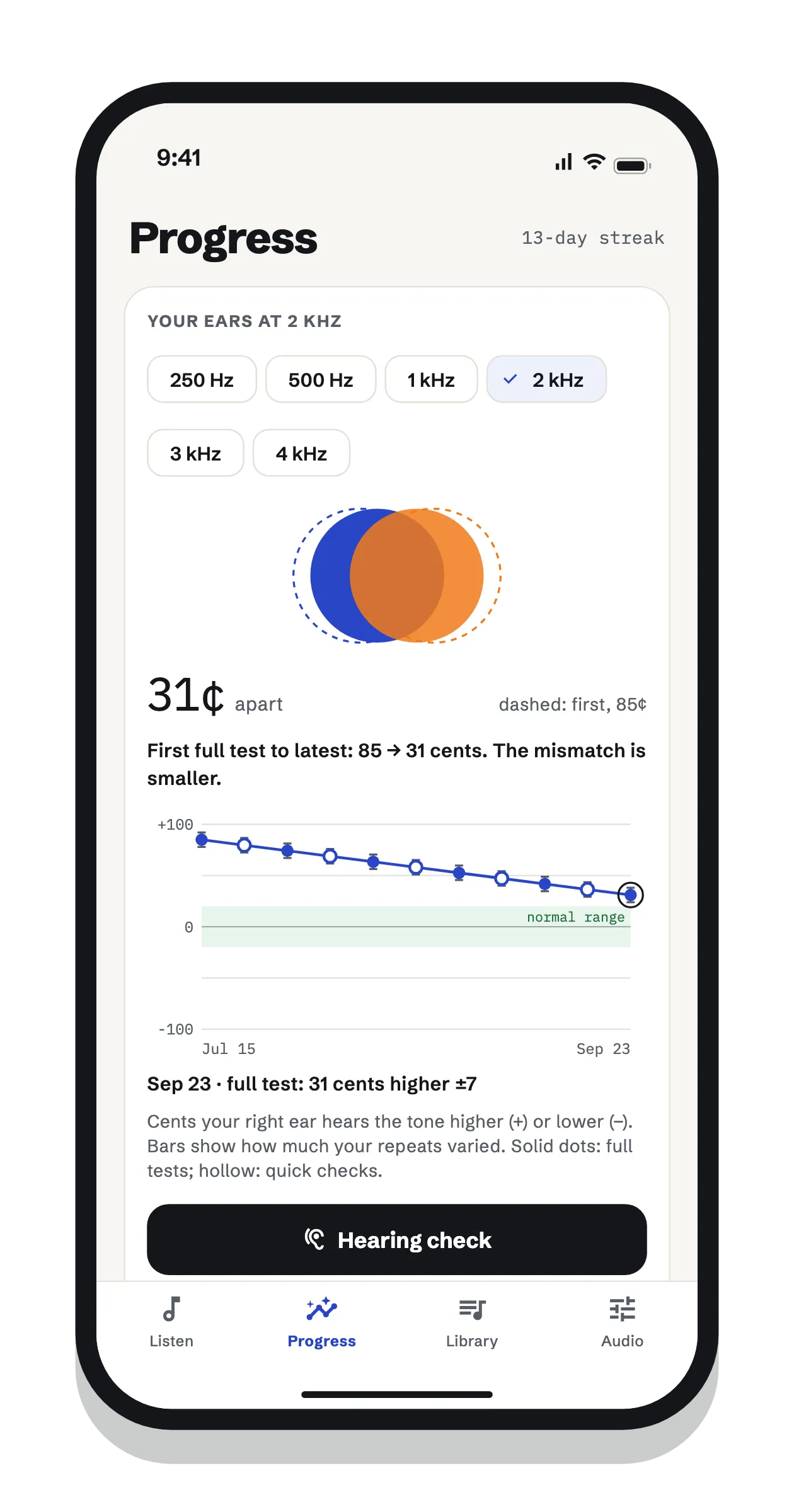
Because there's so little research, your own data is the most useful evidence you'll have.
A mismatch measured the same way every week or two shows whether yours is improving, holding
steady or getting worse. That's worth sharing with your audiologist, and it's reassuring when
it's improving. How you feel music sounds on a given day can swing with tiredness,
noise and mood; a measurement is steadier.
To be meaningful, measurements need to be comparable:
- the same headphones, at the same volume
- loudness matched between the ears first
- several frequencies, with repeats, so you can tell a real change from ordinary variation
Harmonic Recovery does exactly this, and marks changes smaller than your own normal variation
as "no clear change" rather than overclaiming progress.
A new or worsening pitch change needs a doctor. If diplacusis appears
suddenly, or gets worse along with hearing loss, dizziness or a full feeling in the ear, have
it checked rather than waiting to see if it passes.